
Compare and buy an EEG headset in the UK. EEG headbands and headphones from Muse, EMOTIV, NeuroSky and Neurable, with prices from about £100.
An EEG headset reads the tiny electrical signals your brain produces through sensors that rest on your head. Ten years ago that meant a lab. Today you can buy a wireless EEG headband for meditation and sleep, EEG headphones that track focus while you work, or a multi-channel headset for research and brain-computer interface projects. This page explains the different types, what each costs in the UK and where to buy.
| Type | Examples | Best for | Typical price |
|---|---|---|---|
| EEG headband | Muse 2, Muse S Athena, NeuroSky MindWave | Meditation, sleep, home use | £100 to £425 |
| EEG headphones and earbuds | Neurable MW75 Neuro, EMOTIV MN8 | Focus tracking at work | $399 to $699 |
| Multi-channel EEG headset | EMOTIV Insight, EMOTIV EPOC X | Developers, students, BCI | $499 to $1,199 |
| Research EEG helmet or cap | OpenBCI Ultracortex, EMOTIV Flex | Labs and custom research | $1,000 to $3,000+ |
Most popular EEG headband: Muse. Easy to use from your phone, with a 30-day return period. Save 15% with code EKG at the official store.
What is an EEG headset?
EEG stands for electroencephalography, a way of recording the brain’s electrical activity through sensors on the scalp (Mayo Clinic). In hospital, an EEG uses 20 or more wired electrodes and is used to help diagnose conditions such as epilepsy. A consumer EEG headset does a simpler version of the same thing. It places a handful of sensors on your forehead and around your ears, sends the signal wirelessly to a phone or computer and turns it into something useful, such as feedback while you meditate or a sleep report in the morning.
How does an EEG headset work?
Every time groups of brain cells fire together, they produce tiny voltage changes, measured in millionths of a volt. The headset’s sensors pick these up and an amplifier boosts them. Software then filters out noise from blinking and muscle tension. What is left is sorted into brainwave bands, such as alpha waves when you are relaxed with your eyes closed and beta waves when you are concentrating. Apps then use those patterns to estimate whether you are calm or focused, and what stage of sleep you are in.
Dry or wet sensors?
Most consumer EEG headbands use dry sensors that simply touch the skin, so you can put them on in seconds. Research headsets often use saline-soaked felt or gel, which gives better contact through hair but takes longer to prepare and clean. Dry sensors are more sensitive to movement and a loose fit, so a good fit matters more than the spec sheet.
Are EEG headsets accurate?
The better ones are. Independent studies have shown that a Muse headband can capture classic lab brain responses using just a laptop (Krigolson et al., 2017), that an EMOTIV EPOC closely matched a research EEG system (Badcock et al., 2013), and that even a single-sensor NeuroSky correlates with a medical-grade recorder, if more noisily (Rieiro et al., 2019). Consumer headsets are still wellness and research tools. They cannot diagnose a medical condition.
How much does an EEG headset cost?
EEG headset prices in the UK fall into four clear bands. What you pay mostly reflects how many sensors you get and how much you can do with the data.
| Budget | What you get | Examples |
|---|---|---|
| About £100 to £150 | Single-sensor headsets for learning and simple games | NeuroSky MindWave Mobile 2, Macrotellect BrainLink |
| About £240 to £425 | Four-channel headbands with polished apps and sleep tracking | Muse 2, Muse S Athena |
| About $400 to $700 | EEG headphones and five-channel headsets | EMOTIV MN8, Neurable MW75 Neuro, EMOTIV Insight |
| $1,000 and up | 14 to 32 channels for research and development | EMOTIV EPOC X, OpenBCI Cyton, Neurosity Crown |
Remember running costs. Muse’s subscription is optional, but EMOTIV charges for its EmotivPRO software if you want to export raw EEG, and research kits need electrodes and frames on top of the board. Headsets bought direct from overseas may also add VAT and import charges at checkout.
Cheap EEG headsets
The cheapest credible EEG headsets are single-sensor models such as the NeuroSky MindWave Mobile 2 at about $130. They are fine for school projects and learning how EEG works, but one sensor on the forehead tells you far less than a multi-channel headset. If your budget stretches a little, a used Muse 2 is often a better buy than any new single-sensor headset.
How much is an EEG machine?
A clinical EEG machine used in hospitals, with a full cap of 19 or more electrodes and medical certification, typically costs several thousand pounds and needs a trained technician. That is a different product from a personal EEG headset. If you need an EEG test for a medical reason, it is arranged through your GP or a specialist rather than bought.
EEG headbands
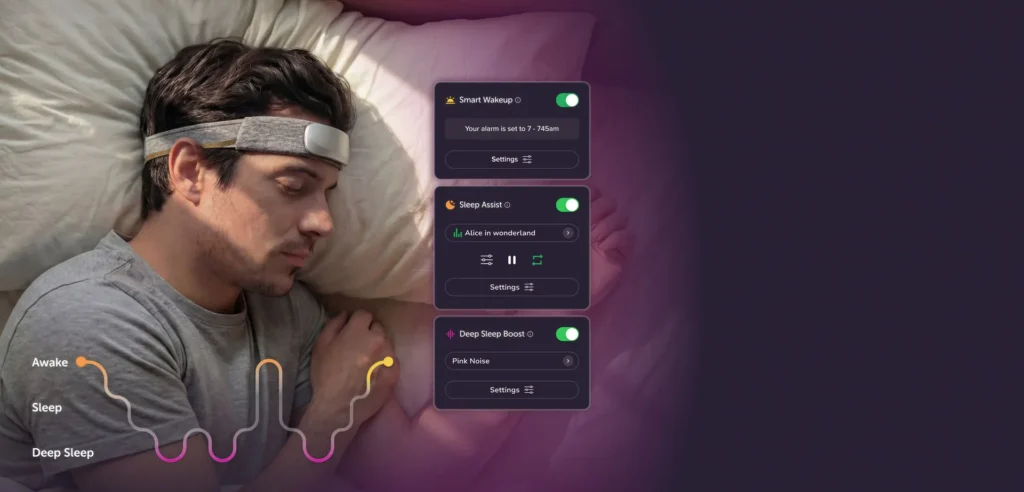
An EEG headband is the most popular type for home use. The band sits across your forehead and, on Muse models, tucks behind your ears, holding a few dry sensors against the skin. Muse is the best-known brand. Muse 2 gives real-time EEG feedback during meditation for about £240, and Muse S Athena adds a soft fabric band you can sleep in plus overnight sleep staging, for about £405 to £425. Read more in our Muse headband UK guide.
EEG headbands for sleep
An EEG sleep headband reads your brain directly through the night, which lets it tell sleep stages apart more reliably than a wrist or ring tracker. In a 2026 University of Ottawa study, Muse sleep staging reached substantial agreement with a full hospital sleep test (SLEEP Advances, 2026). Muse S Athena is the main option sold in the UK.
EEG headphones and earbuds
EEG headphones hide the sensors in the ear cushions or earbuds, so you can track your brain while you work or listen to music. Neurable’s MW75 Neuro, made with Master & Dynamic, is a premium noise-cancelling headphone that monitors focus and mental fatigue, from $499 for the lighter LT model. EMOTIV’s MN8 earbuds offer two channels of ear-EEG for $399. They are the most discreet EEG devices you can buy. The trade-off is that sensors in or around the ear pick up less of the brain than a headband across the forehead, so they suit passive tracking better than meditation training.
What are EEG headphones used for?
Mostly focus and productivity. The apps estimate when your attention is dropping or fatigue is building and suggest a break, and some add brain-age or cognitive scores over time. For guided meditation or neurofeedback, an EEG headband usually gives clearer feedback. Our guide to home neurofeedback devices compares both.
EEG headsets for research and developers
If you want to record and analyse EEG yourself, look at EMOTIV and OpenBCI. The EMOTIV Insight has five sensors at standard positions for $499, and the 14-channel EPOC X costs $999 to $1,199. Both come with software for brain-computer interfaces, though raw data export needs a paid plan. Our Muse vs EMOTIV comparison explains the trade-offs.
EEG helmets and caps
For more channels, research groups use an EEG helmet or cap. OpenBCI’s Ultracortex is a 3D-printable helmet that pairs with its open-source Cyton board for 8 or 16 channels, with complete kits from about $3,000. EMOTIV’s Flex cap offers up to 32 channels. These give the most lab-like data, but they take real time to set up and are rarely the right first purchase.
Can EEG headsets be used for gaming?
Yes, within limits. EMOTIV’s BCI software lets you train a headset to recognise a few mental commands, such as “push” or “lift”, and map them to actions in a game or app. Developers also use OpenBCI and EMOTIV kits to build their own brain-controlled games. It works, but it is slow and takes practice, so think of an EEG gaming headset as an experiment rather than a replacement for a controller.
EEG devices for home use
A home EEG device can help you build a meditation habit or track your sleep. You can also try neurofeedback, where you learn to shift your brain activity using real-time feedback (see our pick of the best home neurofeedback devices). It cannot replace a medical EEG or diagnose anything. For most people, a Muse headband is the easiest personal EEG device to start with, because it runs from a phone app and needs no technical setup.
How to choose an EEG headset
- Start with your goal: meditation and sleep point to a headband, focus at work to headphones, data or research to a multi-channel headset, and a tight budget to a single-sensor model.
- Check the platform: Muse runs from a phone, while EMOTIV and OpenBCI are built around a computer.
- Count the running costs: software subscriptions can cost more than the hardware over a year.
- Think about comfort: a headset you enjoy wearing every day beats a more capable one left in a drawer.
For our ranked picks with pros and cons, see the best EEG headsets in the UK.
Where to buy an EEG headset in the UK
Muse sells through its own UK store, where code EKG takes 15% off, and through UK retailers including Amazon UK. EMOTIV, Neurable, NeuroSky and OpenBCI mostly sell direct and ship to the UK, so check whether VAT and duty are included before you pay. Online purchases in the UK carry a 14-day right to cancel by law, and Muse adds a 30-day return period. You can also browse current deals in our EEG headset shop.
Buying your first EEG headband? Muse S Athena and Muse 2 are the easiest to start with. Save 15% with code EKG.
EEG headset FAQs
What is an EEG headset?
A wearable device with sensors that record the brain’s electrical activity through the scalp and send it wirelessly to a phone or computer, usually for meditation, sleep tracking, neurofeedback or research.
How much does an EEG headset cost?
From about £100 for a single-sensor headset, £240 to £425 for a Muse headband, around $500 for an EMOTIV Insight and $1,000 or more for research systems.
What is the cheapest EEG headset?
Single-sensor models such as the NeuroSky MindWave Mobile 2, at about $130, are the cheapest credible options.
What is the difference between an EEG headband and an EEG headset?
A headband is a slim band with a few sensors across the forehead, designed for comfort and home use. A headset usually has more sensors spread across the head, aimed at data collection and research.
Are EEG headphones accurate?
They can track broad states such as focus and fatigue, but sensors around the ear capture less of the brain than a forehead headband, and most accuracy data so far comes from the manufacturers.
Can I use an EEG headset at home?
Yes. Consumer EEG headsets are designed for home use and connect to a phone or computer. They are not medical devices and cannot diagnose conditions.
Can an EEG headband help with sleep?
An EEG sleep headband such as Muse S Athena can stage your sleep from brain signals and play sounds designed to help you drift off and deepen sleep.
About eeg.org.uk
eeg.org.uk has covered consumer EEG and brain-sensing wearables since 2021. We compare devices on published specifications and UK prices, check the independent research, and link to our sources so you can check them. We earn a commission on some links, including Muse and Amazon, at no extra cost to you. See our affiliate disclosure, or read more about eeg.org.uk.
Sources
- Mayo Clinic: EEG (electroencephalogram)
- Krigolson OE et al. Choosing MUSE: validation of a low-cost, portable EEG system for ERP research. Frontiers in Neuroscience, 2017
- Badcock NA et al. Validation of the Emotiv EPOC EEG gaming system. PeerJ, 2013
- Rieiro H et al. Validation of EEG recordings from a consumer-grade, single dry electrode device. Sensors, 2019
- Portable EEG sleep monitor vs level 1 polysomnography. SLEEP Advances, 2026