
Muse Brain Age claims to show if your brain is ageing faster than you. We checked the research: real accuracy, what moves it, dementia links and what you need to get started.
Stay up all night and a brain-scanning algorithm will think you have aged one to two years. Sleep it off and the extra years vanish. That finding, from a 2023 study in the Journal of Neuroscience, is the best way to understand what “brain age” really is. It is a reading of how your brain is behaving, measured against what is typical for people your age.
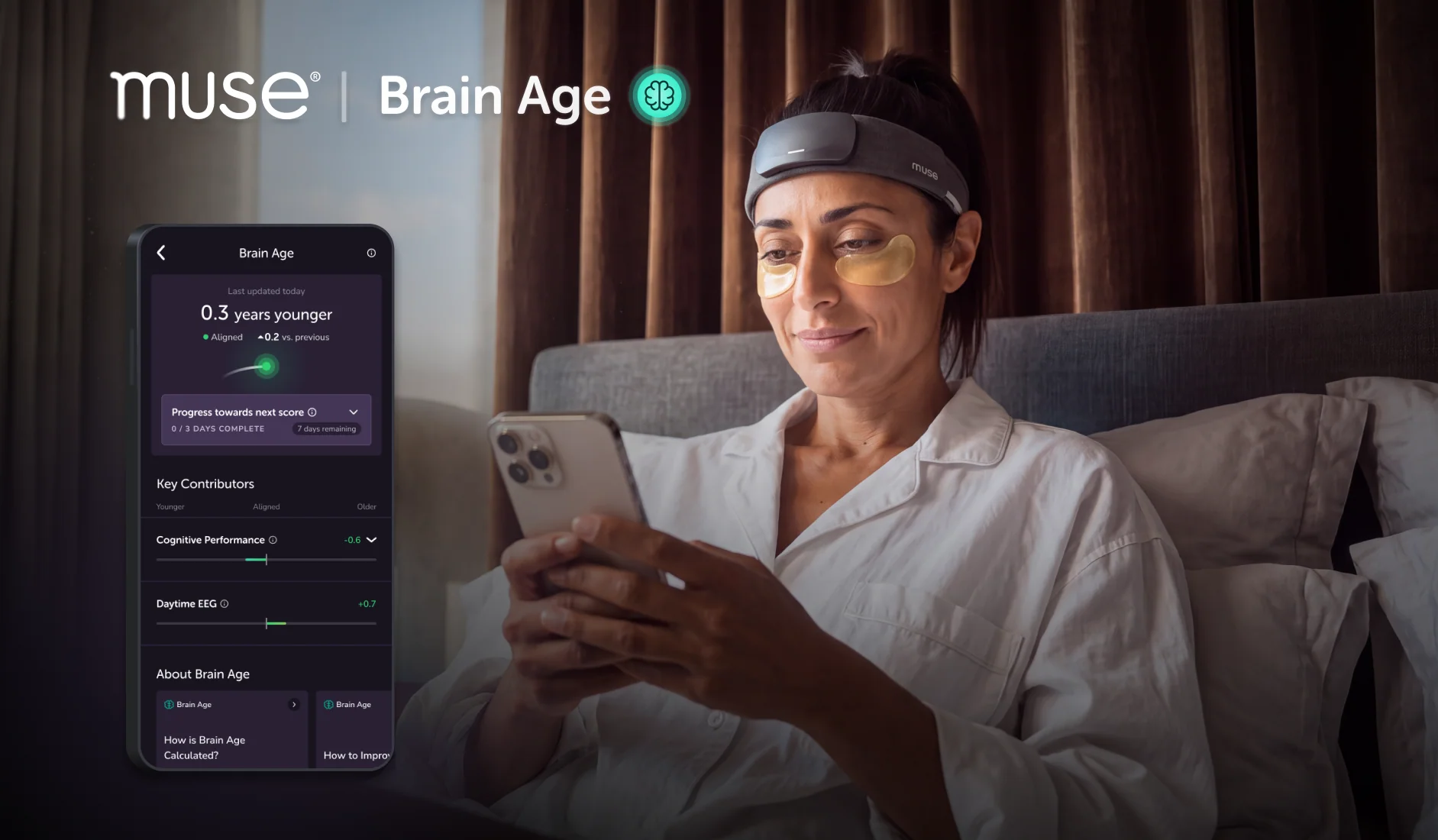
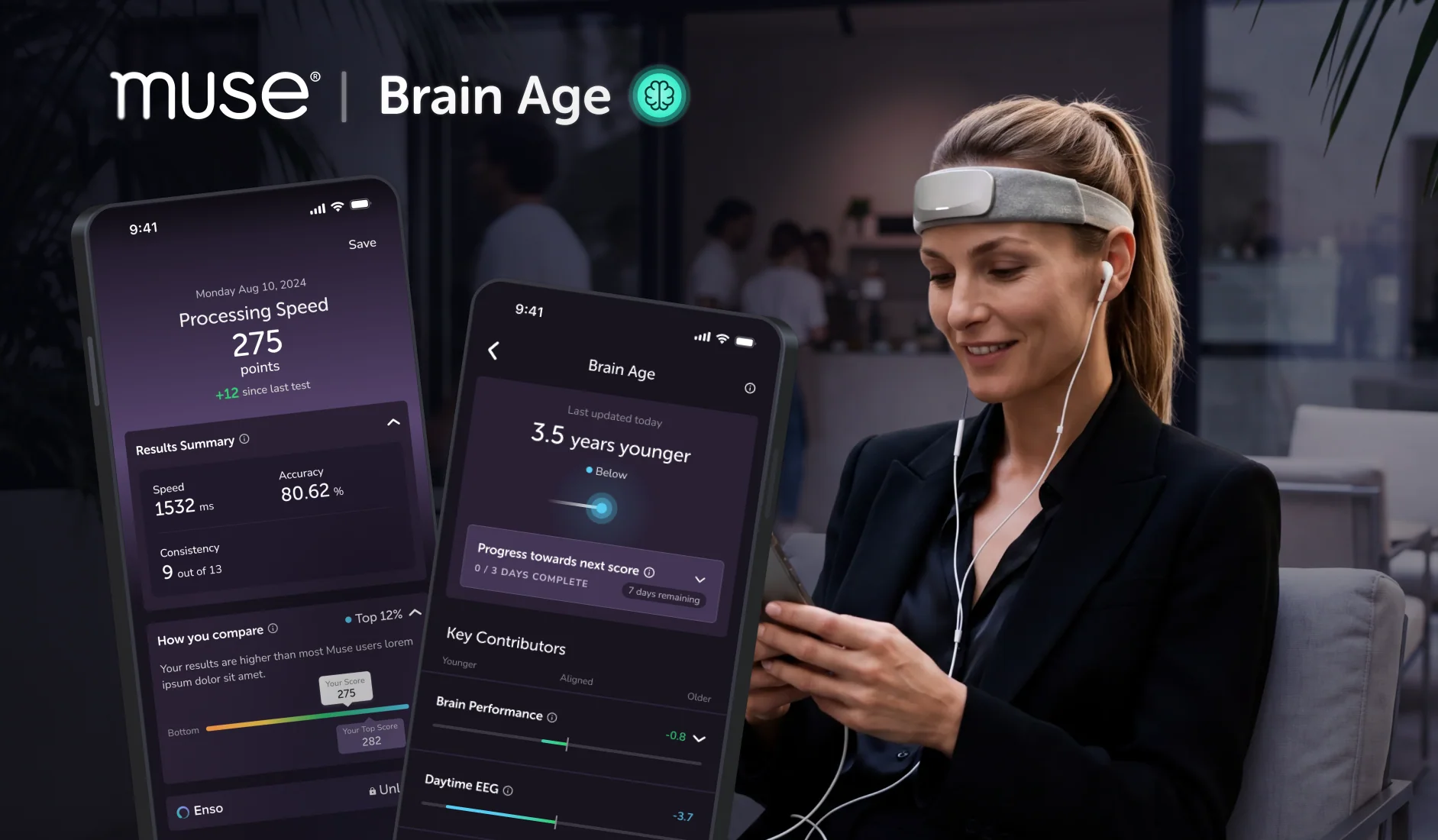
Today (19 October 2026) Muse starts rolling out Muse Brain Age, a weekly number that tells you whether your brain is tracking younger or older than your passport says. It runs on the Muse headbands people already own. So the obvious questions follow. How does a four-sensor headband guess your brain’s age? How accurate is it? And if yours comes back “five years older”, should you worry?
We went through Muse’s launch material, the peer-reviewed study it is built on and the wider brain age research to answer the questions people are actually asking. New to the headbands themselves? Start with our Muse headband guide.
Muse Brain Age in 30 seconds
- Shows your brain age as a gap in years (for example “3.5 years younger”), never as an absolute age.
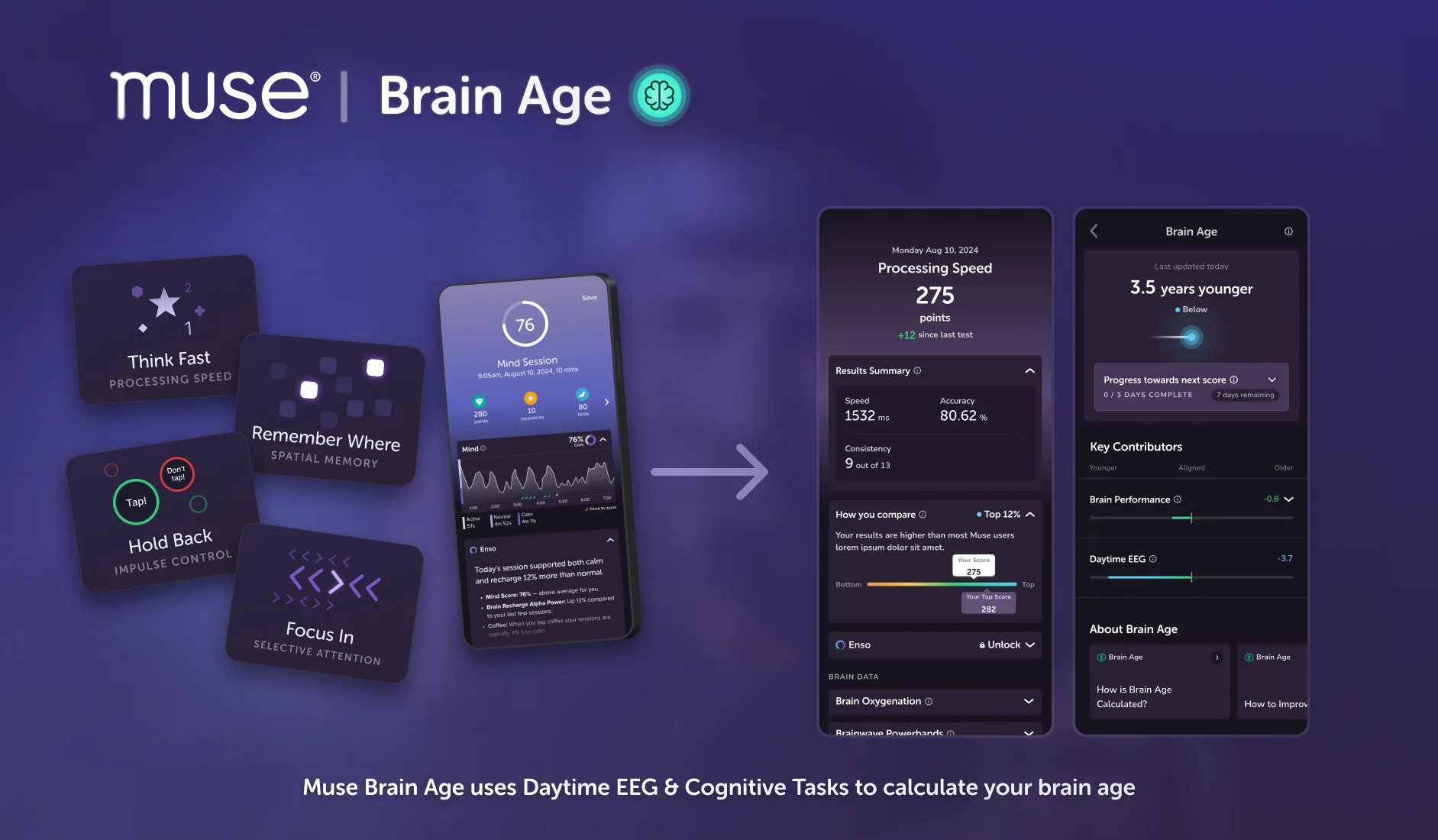
- Combines EEG from your normal eyes-closed Muse sessions with four one-off cognitive tests.
- Updates every Monday. Muse puts average error at about 3.8 years, while the published study behind it reports roughly 7.
- First reading is free on Muse 2, Muse S and Muse S Athena. Ongoing weekly readings need Muse Premium.
Want to find out your own brain age? You need a Muse headband and about 10 minutes a day for a week. Your first reading is free.
What is “brain age”, in plain English?
Brain age is an estimate of how old your brain looks, based on patterns that change predictably over a lifetime. Researchers train a model on thousands of people whose real ages are known. The model learns what a typical 30-year-old brain looks like compared with a typical 70-year-old one. Then it guesses the age of a new brain.
The interesting part is the miss. If the model says 52 and you are 47, your brain age gap is +5. A positive gap means your brain looks older than expected. A negative gap means it looks younger.
Most brain age research uses MRI scans, which measure structure: grey matter volume, cortical thickness, fluid spaces. EEG is different. It measures electrical activity, so an EEG brain age reflects how your brain is working rather than how it is built. That is why it can shift in ways an MRI-based age cannot.
How does Muse Brain Age actually work?
Muse headbands carry four dry EEG sensors, two on the forehead and two behind the ears. During a normal eyes-closed session they record your brainwaves. Muse Brain Age pulls from two sources:
| Input | What it measures | What you do |
|---|---|---|
| Daytime EEG | Your brain’s electrical activity at rest with eyes closed | At least 10 minutes a day of Mind, Body, Breath, Heart or Guided sessions (each one 2 minutes or longer) |
| Cognitive tests | Processing speed, spatial memory, impulse control and selective attention | Complete all four once to unlock your first reading |
Sleep sessions do not count, which surprised some Muse S owners. Neither do Strength sessions.
What is it reading in your brainwaves?
The clue is in the 2024 study the feature is built on. When Muse’s researchers checked which signals their model leaned on, the low and mid alpha bands (8 to 12 Hz) mattered most for awake recordings. That fits decades of research showing your alpha peak frequency slows as you get older. Think of it as the resting rhythm of a relaxed, awake brain. In younger adults it tends to sit higher. With age it drifts down.
Muse has actually been watching this happen for a decade. A 2016 study in eNeuro used early recordings from 6,029 Muse users aged 18 to 88. Peak alpha frequency slowed by more than 1 Hz between early and late adulthood, a steady year-on-year decline. Slower brain rhythms (delta and theta) faded with age while alpha and beta power rose. That dataset is part of why Muse could build a brain age feature at all.
The new model is far bigger than the research version. Muse says the 2024 study used a model with around 3,300 parameters, while the one in the app has about 300 million.
How long until I get my first reading?
At least eight days. You need 10 qualifying minutes on 7 different days (they do not have to be consecutive) plus all four tests. Your first reading then lands on the following Monday. After that, sessions on 3 days a week keep it current. Skip a week and no new reading appears, but your old one does not reset.
Start your 7-day Brain Age calibration
First Brain Age reading free on any Muse headband
How accurate is Muse Brain Age?
This is the question that matters, and the answer has two numbers in it.
Muse says its in-app model lands within about 3.8 years of real age on average. On its own Brain Age product page, though, it also states ±7 years, published. Both are true. They describe different things.
- The 7-year figure comes from the peer-reviewed research. Banville and colleagues (Imaging Neuroscience, 2024) trained models on more than 5,200 at-home Muse recordings from people aged 18 to 81. Their best sleep-based model averaged 7.6 years of error, which matched a lab-based sleep EEG study reporting 7.8 years. Awake meditation recordings did a little worse on their measure of fit.
- The 3.8-year figure is Muse’s much larger in-house model, which also adds the cognitive tests. It has not been published in a journal yet.
For context, the best MRI brain age models now hit around 2.7 to 3.2 years. A strong MRI result in a scanner costing millions, versus 3.8 claimed from a headband on your sofa. If the in-app number holds up under independent testing, that is genuinely impressive. Until then, treat it as a company figure.
One honest caveat from the study itself: the dataset had no medical records or cognitive testing, so the researchers could not check whether an “older” EEG brain actually meant anything clinically. They also could not confirm that every user entered their real date of birth.
Why does my brain age change every week?
Because a single session is noisy. Very noisy.
In the 2024 study, researchers tracked a handful of heavy users over periods of up to 529 days. Session to session, an individual’s brain age bounced around with a standard deviation of 3.5 to 6 years for meditation recordings. Yet the long-term trend lines were almost flat. Your brain was not ageing and un-ageing by years each day. The reading was picking up your state (tired, stressed, distracted) on top of your trait (how your brain is ageing).
Another sleep EEG study found a night-to-night swing of 7.5 years for one person, which fell to 3 years once four nights were averaged. That is exactly why Muse waits for a week of data before giving you a number. Even then, Muse says weekly readings typically move by about 1.9 years. So a jump from “1 year younger” to “1 year older” is probably noise. Give it several weeks before reading anything into a trend.
Can one bad night make your brain look older?
Yes, at least to an algorithm. In the Journal of Neuroscience study mentioned at the top, researchers scanned 134 healthy adults aged 19 to 39. After total sleep deprivation (more than 24 hours awake), MRI brain age rose by 1 to 2 years. After one night of recovery sleep, it was back to baseline.
The surprise was what did not move the needle. A single 3-hour night, or five nights of 5 hours in bed, produced no significant change in MRI brain age. That does not mean short sleep is harmless. It means a one-off all-nighter shows up more clearly than mild restriction, at least in brain structure scans.
For EEG, the effect is likely stronger, because fatigue changes your brainwaves directly. Research on mental fatigue shows power in several EEG bands rises as you tire, and the 2024 Muse study flagged sleep quality and tiredness as probable causes of day-to-day swings. Translation: do not do your Muse sessions after a red-eye flight and expect a flattering result.
What is a “normal” brain age gap?
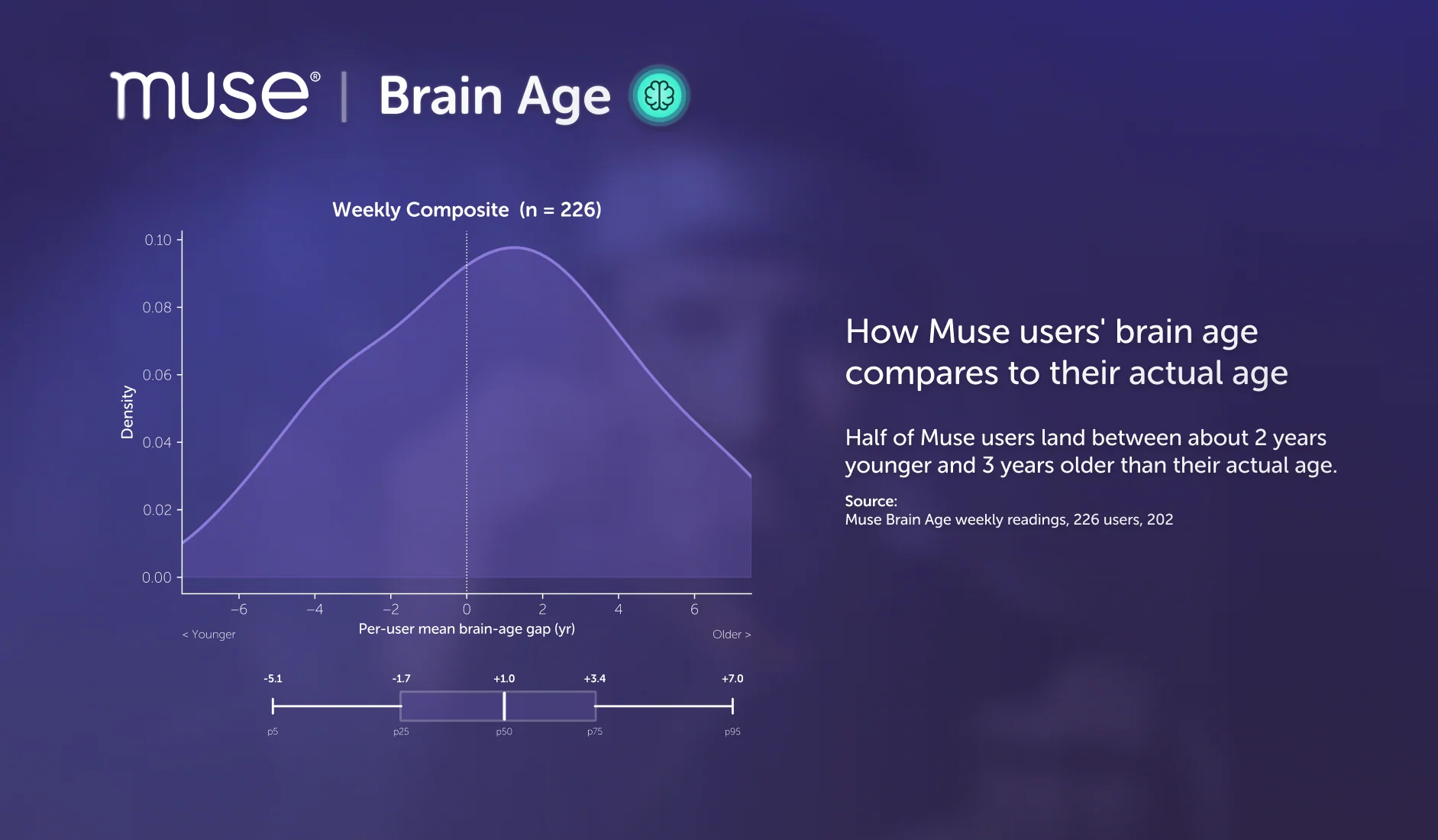
Muse has published an early snapshot from 226 users of the feature. Half landed between about 2 years younger and 3 years older than their actual age. So if yours says “1.5 years older”, you are squarely in the middle of the pack.
Bigger gaps exist, and with an average error of several years, a reading of 5 or 6 years either way can still be within the margin of error for an individual. The direction of your line over months tells you far more than any single number.
Younger or older than the pack? The only way to know where your brain sits is to measure it. Muse 2 is the entry-level headband that supports Brain Age.
Do women have younger brains than men?
On average, it looks that way. A 2019 study in PNAS scanned 205 adults aged 20 to 82 and estimated brain age from how the brain uses glucose. Women’s brains came out about three years younger than men’s of the same age. When the model was trained only on men’s scans, women read 3.8 years younger.
Nobody knows exactly why, and the result used metabolic brain imaging rather than EEG. Muse has not said whether its model adjusts for sex. So if you and your partner compare readings over breakfast, keep that in mind before declaring a winner.
What makes a brain look older?
Beyond sleep loss, two everyday factors have unusually clear brain age data behind them. Both come from MRI studies, so they describe brain structure rather than the EEG signal Muse reads.
Alcohol
A Nature Communications analysis of 36,678 UK Biobank adults found that going from one to two units a day was linked to brain changes equivalent to about 2 years of extra ageing. Going from two to three units a day matched roughly 3.5 years. For a UK reader, two units is about one pint of ordinary-strength beer. These are associations at population level, but the dose pattern is hard to ignore.
Social isolation
The long-running Dunedin Study in New Zealand tracked people from childhood to age 45. Those who became socially isolated in adulthood had MRI brain ages about 1.73 years older than people who were never isolated. Isolation in childhood alone showed no link. The authors point out the arrow could run both ways, since an older-looking brain might also make people withdraw.
Does an older brain age mean dementia?
Muse is blunt about this: Brain Age is not a medical test and does not diagnose, detect or predict dementia or any other condition. That is the correct position, and here is why the question still comes up.
In MRI research, a bigger brain age gap does track with risk. A UK Biobank analysis of almost 39,000 people found each extra year of gap was linked to a 16.5% higher risk of Alzheimer’s disease and a 12% higher risk of death from any cause. Sleep EEG shows a similar pattern. A UCSF-led pooled analysis, following adults for up to 17 years, linked every 10-year increase in sleep-based brain age to roughly 39% higher dementia risk. People with mild cognitive impairment in one sleep EEG study read nearly nine years older than their real age.
Three cautions before anyone panics. First, those findings describe large groups, not individuals. Second, they come from MRI scanners and clinical sleep recordings, not a consumer headband used during the day. Third, nobody has yet shown that Muse’s awake-EEG brain age predicts any health outcome. The UCSF researchers themselves described their measure as a population marker that is not ready to be a diagnostic test.
If you have real concerns about memory or thinking, the right move is a conversation with your GP, not a headband.
Can you make your brain younger?
Muse itself does not claim its sessions will lower your Brain Age. The wider research is more interesting, though everything below is association rather than proof.
Sleep well, consistently
Better overall sleep health, including 7 to 8 hours a night and fewer problems like insomnia or snoring, has been linked to a younger brain age gap in MRI studies. Given how much a lost night shifts the reading, this is the most obvious lever you have.
Stack healthy habits
A University of Florida study followed 128 middle-aged and older adults for two years using MRI brain age. Those with the most protective factors (restorative sleep, optimism and stress management, a healthy waistline, avoiding tobacco and supportive relationships) had brains that looked up to 8 years younger and kept ageing more slowly. Most participants lived with chronic knee pain, which makes the result more striking, not less. Hardships like chronic pain, lower income and less education were tied to older-looking brains.
Exercise, especially strength work
Randomised trials summarised by researcher Rhonda Patrick reported resistance training cut the brain age gap by roughly 1 to 2 years in older adults, with endurance training also producing a smaller drop. Being randomised, these are among the better pieces of evidence in the field.
Meditation
A study of advanced practitioners of Inner Engineering meditation found their sleep EEG brain age was 5.9 years younger than their real age. The authors are clear that the study cannot prove meditation caused it, since there was no baseline before people started practising. Still, it is the finding Muse fans will quote most, given that the headband is built around meditation. If guided meditation with live brainwave feedback is what interests you, our round-up of the best home neurofeedback devices compares the options.
Changing your sleep, drinking or exercise habits? A weekly Brain Age gives you a way to see whether anything shows up in your brainwaves over the following months, rather than guessing.
Can you cheat your Muse Brain Age?
Partly, and Muse has designed around it. Cognitive test scores improve with practice, as they do in any brain-training app. So Muse shows your test performance and your EEG reading separately. If your Brain Age improves, the app tells you whether your brainwaves moved, your test scores moved or both. A better score from simply getting good at the tests will be visible for what it is.
What you can legitimately do is reduce noise. Do sessions when you are reasonably rested, in a quiet spot, with a good sensor fit. Consistent conditions give you a cleaner line.
Time of day may matter a little too. In the 2024 study, recordings made later in the day leaned very slightly younger. The effect was tiny, but if you want comparable readings week to week, sticking to roughly the same session time costs nothing.
Compare Muse 2 and Muse S Athena
30-day money-back guarantee from Muse
Muse Brain Age vs Neurable Brain Age
Muse is not first. Neurable added a weekly Brain Age score to its MW75 Neuro LT headphones, which use 12-channel EEG built into fabric ear cushions. Here is how they line up. For the wider field of consumer EEG, see our guide to the best EEG headsets in the UK.
| Muse Brain Age | Neurable Brain Age | |
|---|---|---|
| Hardware | Muse 2, Muse S or Muse S Athena headband | MW75 Neuro LT headphones |
| How EEG is captured | Dedicated eyes-closed sessions, 10 min a day | Passively while you wear the headphones |
| Extra inputs | Four cognitive tests | Not disclosed |
| Published research | 2024 peer-reviewed study (Imaging Neuroscience) | No published methodology, according to Muse |
| Update day | Monday | Sunday |
The trade-off is effort versus evidence. Neurable collects data while you work or listen to music. Muse asks for 10 deliberate minutes a day but can point to published research. Note that the “not published” points come from Muse’s own comparison.
What do you need for Muse Brain Age?
Your first reading is free on any Muse headband. Weekly readings, history and trend charts after that come with Muse Premium.
How does the Muse Premium subscription work?
You do not need Premium to use a Muse. The free tier is yours for good and covers core meditations and sleep features: sleep tracking, Sleep Assist and Deep Sleep Boost. Premium sits on top and is where the brain metrics live.
| Free | Premium | |
|---|---|---|
| Core meditations and sleep tracking | Yes | Yes |
| Muse Brain Age | First reading only | Weekly readings, history and trends |
| Alpha Peak and Brain Recharge Score | No | Yes |
| 500+ guided sessions, expert programmes and Enso AI Coach | No | Yes |
| External Audio (use Muse with other apps) | No | Yes |
Check where you subscribe. Premium comes as a monthly or annual plan, and you can buy it on the Muse website or inside the app. In-app subscriptions often cost more because app store fees get passed on, so compare the price on the Muse website before you subscribe in the app.
The other route is a bundle. Muse sells each headband with a year of Premium included. This usually works out better value than buying the two separately. To keep the Premium features after that first year, you pay for a subscription separately.
Two things to check before you commit. Muse’s subscription page does not mention a free trial for Premium, though headbands come with a 30-day money-back guarantee. It also does not spell out cancellation or renewal terms, so look at those at checkout. One small quirk: the feature list on that page labels Brain Age as “Athena only”, which conflicts with Muse’s launch material confirming it works on Muse 2, Muse S and Muse S Athena. The launch article is the more detailed and more recent source.
Which one? Muse 2 is the cheapest way in and does everything Brain Age needs. Muse S Athena is the newer, more comfortable fabric band and adds overnight sleep features like Smart Wakeup. If you only want Brain Age, Muse 2 is enough. Our Muse headband guide breaks down the differences in more detail.
Compare Muse bundles with a year of Premium
Bundles usually beat paying for Premium separately in the app
Is my brain data private?
Muse says Brain Age is calculated on its own systems and the app only receives the final reading. It also states that it does not sell brain data. Worth knowing: the 2024 study used anonymised recordings from users whose privacy policy consent covered research use. If that bothers you, read the Muse privacy policy before setting up an account.
Should you buy a Muse just for Brain Age?
Our honest take.
It makes sense if you:
- Already track sleep or heart rate and want a brain number to sit alongside them
- Will genuinely do 10 minutes of eyes-closed sessions most days
- Want to see whether lifestyle changes show up in your brainwaves over months
- Already own a Muse, in which case the first reading costs nothing (just update the app)
Skip it if you:
- Want reassurance about memory or dementia risk (see your GP instead)
- Will check the number once and forget the headband in a drawer
The weekly reading is only useful as a trend, and a trend needs months of sessions. The meditation itself is where most of the day-to-day benefit sits. Brain Age is the scoreboard. Still weighing up Muse against other brands? Our UK EEG headset comparison covers the alternatives.
Get your first Brain Age reading with Muse
Works with Muse 2, Muse S and Muse S Athena
Muse Brain Age FAQs
When does Muse Brain Age launch?
It starts rolling out in the Muse app on 19 October 2026 and should reach all users by 26 October 2026.
Do I need a new headband?
No. It works on Muse 2, Muse S and Muse S Athena.
Is Muse Brain Age free?
The first reading is free. Ongoing weekly readings, history and trends need a Muse Premium subscription.
Do I need Muse Premium to use a Muse headband?
No. The free tier includes core meditations and sleep tracking for good. Premium adds weekly Brain Age, Alpha Peak, Brain Recharge, 500+ guided sessions and the Enso AI Coach.
Do women have younger brains than men?
One 2019 PNAS study of 205 adults found women’s brains looked about three years younger than men’s of the same age, based on brain metabolism. The reason is unknown.
Does alcohol make your brain older?
In a UK Biobank study of 36,678 adults, going from one to two units a day was linked to brain changes equal to about two extra years of ageing.
How accurate is Muse Brain Age?
Muse says its app model averages about 3.8 years of error. The peer-reviewed study it builds on reported around 7 years. The 3.8 figure has not yet been independently published.
Do sleep sessions count towards Brain Age?
No. Only eyes-closed daytime sessions count. Sleep and Strength sessions are excluded.
My brain age says I am older. Should I worry?
Not on one reading. Weekly results typically move about 1.9 years, and half of early users read between 2 years younger and 3 years older. Watch the trend over months. If you have memory concerns, speak to a doctor.
Can Muse Brain Age detect dementia?
No. Muse says it is a general wellness feature that does not diagnose, detect or predict dementia or any other condition.
Can I lower my brain age?
Muse does not claim you can. Research links better sleep, exercise, stress management and not smoking to younger-looking brains, though mostly as associations rather than proven cause and effect.
Does staying up all night age your brain?
Temporarily, in brain scans. One night of total sleep deprivation made MRI brain age 1 to 2 years older in young adults, and it returned to normal after a night of recovery sleep.
How is EEG brain age different from an MRI brain age?
MRI measures brain structure, which changes slowly. EEG measures electrical activity, which reflects how your brain is functioning and can shift with sleep, stress and fatigue.
Sources
- Muse: Muse Brain Age launch article (October 2026)
- Muse: Brain Age product page and FAQs
- Muse: Premium subscription plans and bundles
- Banville et al. (2024), Do try this at home: Age prediction from sleep and meditation with large-scale low-cost mobile EEG, Imaging Neuroscience
- Total sleep deprivation increases brain age prediction reversibly in multisite samples of young healthy adults, Journal of Neuroscience (2023)
- UK Biobank: Brain age gap as a predictive biomarker
- UCSF-led sleep EEG brain age and dementia risk analysis (report)
- University of Florida lifestyle and brain age study, Brain Communications (report)
- Sleep-based brain age in advanced meditators, Mindfulness (report)
- FoundMyFitness: exercise trials and brain age gap
- Hashemi et al. (2016), population EEG patterns in 6,029 Muse users, eNeuro
- Women’s brains appear younger than men’s, PNAS 2019 (report)
- Alcohol and brain ageing in UK Biobank, Nature Communications 2022 (report)
- Social isolation and brain age, Dunedin Study, Psychological Medicine (report)
- Wareable: Neurable MW75 Neuro LT launch