
Muse vs EMOTIV compared, with an EMOTIV Insight and EPOC X review covering raw data costs and smartphone support, plus the best EMOTIV alternatives.
Muse and EMOTIV are the two best-known names in consumer EEG, but they are built for different people. Muse turns brain signals into a guided experience you can use from your phone in a minute. EMOTIV gives you more sensors and more control over the data, and expects you to do more with it. The right choice depends less on channel counts than on what you want to do once the headset is on.
| Muse S Athena | EMOTIV Insight | EMOTIV EPOC X | |
|---|---|---|---|
| Best for | Meditation, sleep, beginners | EEG data, BCI projects | Research and advanced users |
| EEG channels | 4, plus fNIRS | 5 | 14 |
| Sampling rate | 256 Hz | 128 Hz | 128 or 256 Hz |
| Sensors | Dry fabric | Semi-dry polymer | Saline-soaked felt |
| Battery | Up to 10 hours | Up to 20 hours | Up to 9 hours |
| Works with | iPhone and Android app | PC, Mac, tablet | PC, Mac |
| Raw EEG | Via third-party apps | Paid EmotivPRO plan | Paid EmotivPRO plan |
| Price | About £405 to £425 | $499 | $999 to $1,199 |
Most people should start with Muse. It works straight from your phone and needs no subscription. Save 15% with code EKG.

The short answer
Choose Muse if you want an EEG headset for meditation or sleep that works from your phone with almost no setup. Choose EMOTIV if you want to record and analyse EEG yourself, build a brain-computer interface (BCI) or run small research projects, and you are happy to work on a laptop and pay for software.
EMOTIV review: Insight and EPOC X
EMOTIV was founded in 2011 by Tan Le and Geoff Mackellar and is based in San Francisco. Its roots go back to Emotiv Systems in Australia, which released the original EPOC headset in 2009 as one of the first mobile EEG devices. Today the range runs from EEG earbuds to a 32-channel research cap, and EPOC headsets have been used in a large body of published research.
EMOTIV Insight review
The Insight is EMOTIV’s five-channel headset and the one most often compared with Muse. Its sensors sit at five standard EEG positions (AF3, AF4, T7, T8 and Pz), which adds the temples and the back of the head to forehead coverage. Muse reads only the forehead and the area behind the ears. The semi-dry polymer sensors need no gel or saline, battery life is up to 20 hours and EMOTIV lists the price at $499 (EMOTIV Insight specifications).
In use, the Insight is more technical than Muse. It connects to a computer or tablet rather than being built around a phone app, and its sensors need to push through your hair at the back of the head, which can take some adjustment. The reward is data you can actually work with, plus EMOTIV’s mental-command BCI software, which lets you train the headset to recognise thoughts such as “push” or “pull”.
- Pros: wider head coverage than Muse, a 20-hour battery, strong developer tools and EMOTIV’s BCI software.
- Cons: raw EEG costs extra, and there is no polished meditation or sleep experience.
EMOTIV EPOC X review
The EPOC X is EMOTIV’s flagship 14-channel headset, listed at $999 to $1,199 depending on the page you read. It uses saline-soaked felt sensors that need wetting before each session. It records at 128 or 256 samples per second and lasts up to 9 hours. This is a research tool first.
Its research credentials are real. In an independent study at Macquarie University, an earlier EPOC model recorded auditory brain responses that closely matched a lab-grade Neuroscan system when the two were worn at the same time (Badcock et al., PeerJ, 2013). For a university project or a serious BCI build, that matters more than ease of use.
- Pros: 14 channels, a proven research track record, a configurable sampling rate and a wireless design.
- Cons: fiddly wet sensors, and a price that only makes sense if you need the data.
EMOTIV MN8 earbuds
EMOTIV also sells MN8, a pair of two-channel EEG earbuds at $399, and has added newer MW20 earbuds. They are discreet enough to wear at work and suit passive tracking of attention and stress. Two channels inside the ear tell you far less than a headset, so treat them as a different product category.
The catch: EMOTIV software costs
This is the part most EMOTIV reviews skip. The free EmotivPRO Lite tier gives you processed metrics such as attention and stress, but exporting raw EEG needs a paid plan. EMOTIV lists EmotivPRO Standard at $149 a month, or $89 a month paid annually (EmotivPRO licensing). Over a year that can cost more than the headset. Student and academic pricing exists, so check it if you qualify.
Is EMOTIV worth it?
For developers and researchers, yes. EMOTIV gives you standard sensor positions and mature software, backed by a long publication record at a fraction of the cost of a clinical EEG system. For someone who wants to meditate better or track sleep, no. You would pay more and do more setup, and still not get the guided experience Muse offers.
Muse S Athena review
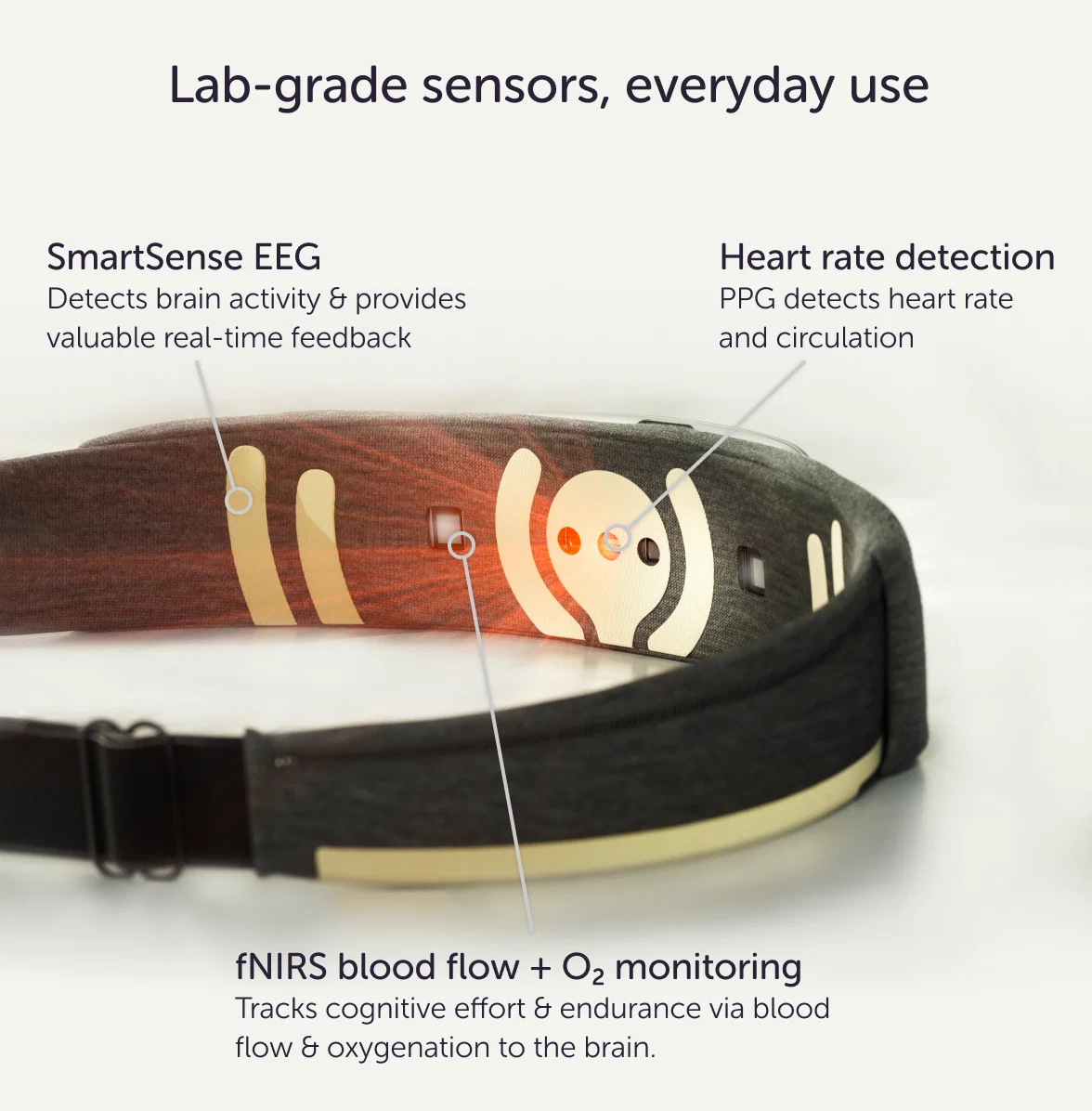
Muse S Athena is a soft fabric headband with four EEG channels, a 256 Hz sampling rate and dry sensors, plus fNIRS, a light-based sensor that measures blood oxygen in the front of the brain. It pairs with a phone over Bluetooth and turns your brain activity into sound while you meditate: calm brings birdsong, a wandering mind brings wind and rain. You can also wear it overnight, and it stages your sleep from brain signals.
Muse has the stronger evidence for everyday use. University of Victoria researchers showed a Muse could capture classic lab brain responses with just a laptop (Krigolson et al., Frontiers in Neuroscience, 2017). In a 2026 University of Ottawa study, Muse sleep staging reached substantial agreement with full hospital polysomnography (SLEEP Advances, 2026). EMOTIV has nothing comparable for sleep.
- Pros: easiest setup of any EEG headset, phone app, sleep tracking, no subscription needed.
- Cons: fixed training programmes, and raw data needs third-party apps such as Mind Monitor.
Prefer something cheaper? Muse 2 offers the same core EEG feedback for about £240, without fNIRS or sleep tracking. Our Muse headband UK guide compares the two in detail.
Try Muse at home. If it does not suit you, Muse gives you 30 days to send it back.
Insight vs Muse: head to head
| Category | Winner | Why |
|---|---|---|
| Beginners | Muse | Phone app and guided sessions |
| Raw EEG data | EMOTIV | Official tools and standard sensor positions |
| Head coverage | EMOTIV | Insight adds temples and the back of the head |
| Sleep tracking | Muse | Athena is built to be worn overnight |
| Sampling rate | Muse | 256 Hz against Insight’s 128 Hz |
| Battery life | EMOTIV | Insight lasts up to 20 hours |
| BCI and mental commands | EMOTIV | Dedicated BCI software and SDK |
| Running costs | Muse | Free app covers the core features |
Channel count alone does not settle it. Placement, sensor contact, movement and the software reading the signal all affect what you get. Five channels on a headset you never set up properly are worth less than four channels on one you use every day.
Which wireless EEG device connects to smartphones?
Muse is the simplest. Muse 2 and Muse S Athena connect over Bluetooth to the free Muse app on iPhone and Android, and the whole experience is designed around the phone. Neurable’s EEG headphones and Mendi’s fNIRS headband also run from phone apps. EMOTIV’s Insight and EPOC X are built to work with a computer or tablet, so they are less convenient if you want to train on the move.
What sampling rates do portable EEG systems offer?
Most consumer EEG headsets record between 128 and 256 samples per second on each channel. Muse records at 256 Hz, EMOTIV Insight at 128 Hz and the EPOC X at 128 or 256 Hz, set by the user. For the brainwave bands used in meditation and neurofeedback, which sit roughly between 1 and 40 Hz, either rate is enough. A higher rate mainly helps with faster signals and precise timing in research.
Best EMOTIV alternatives
- Muse S Athena: the best alternative if you want sleep tracking and a phone app.
- Muse 2: the cheapest way into well-validated EEG feedback, at about £240.
- Neurosity Crown: an eight-channel headset aimed at developers, with an open software kit and no subscription for raw data, at around $1,499.
- OpenBCI: open-source boards and headsets for people who want full control over hardware and data.
- Neurable MW75 Neuro: EEG built into premium noise-cancelling headphones, for focus tracking at work.
- NeuroSky MindWave Mobile 2: a single-channel budget option for simple experiments.
For a wider comparison, see our guides to the best EEG headsets in the UK and the best home neurofeedback devices.
Our verdict
For most UK buyers, Muse is the better choice. It is easier to use, works from your phone, tracks sleep and costs nothing extra to run. EMOTIV wins for anyone whose main goal is the EEG data itself, whether for research or building a BCI, provided you budget for the software. The EPOC X is the one to buy if you need research-grade coverage, and the Insight suits lighter developer projects.
Our pick for most people: Muse S Athena. Save 15% with code EKG at the official Muse store.
Muse vs EMOTIV FAQ
Is Muse or EMOTIV better?
Muse is better for meditation and sleep, especially for beginners. EMOTIV is better for raw EEG data and brain-computer interface projects.
Is EMOTIV worth buying?
Yes, if you want to work with EEG data and are prepared to pay for EmotivPRO to export it. For wellbeing use, Muse gives more for less money.
Does EMOTIV need a subscription?
The headsets work with free software that shows processed metrics, but exporting raw EEG needs a paid EmotivPRO plan, listed from $89 a month on an annual plan.
Can EMOTIV Insight connect to a phone?
EMOTIV builds the Insight around computer and tablet software. If you want a headset designed around a phone app, Muse is the better fit.
Is Muse or EMOTIV easier for beginners?
Muse. It uses dry sensors, pairs with a phone in about a minute and guides you with sound. EMOTIV assumes you are comfortable with computer software.
What is the sampling rate of Muse?
Muse records EEG at 256 samples per second per channel. EMOTIV Insight records at 128.
Are Muse and EMOTIV medical devices?
No. Both are sold for wellness and research use. Neither is intended to diagnose or treat a medical condition.
What is the best alternative to EMOTIV?
Muse S Athena for everyday users, and the Neurosity Crown or OpenBCI for developers who want raw data without an ongoing software fee.
How we compared Muse and EMOTIV
eeg.org.uk has covered consumer EEG since 2021. For this comparison we checked each headset’s published specifications and software pricing from the manufacturers, and read the independent research behind both brands, listed below. Where a figure comes from a manufacturer, we say so. We may earn a commission when you buy through some of our links, such as Muse and Amazon, at no extra cost to you, and we recommend EMOTIV where it is the better tool. See our affiliate disclosure, or read more about eeg.org.uk.
Sources
- Badcock NA et al. Validation of the Emotiv EPOC EEG gaming system for measuring research quality auditory ERPs. PeerJ, 2013
- Krigolson OE et al. Choosing MUSE: validation of a low-cost, portable EEG system for ERP research. Frontiers in Neuroscience, 2017
- Assessing the performance of a portable EEG sleep monitor against level 1 polysomnography. SLEEP Advances, 2026
- EMOTIV: Insight technical specifications
- EMOTIV: EmotivPRO licensing